

“Go back to memes”, “Don’t feed into the drama”, “you’re incels who bang their wives(?!?!?)”. We have heard the objections from the casuals and the shrieking from the fruit loop gallery. Beyond the memes there is discourse. Discourse is one of our most consistent and cherished traditions. From pshat to Gemara to diaries and manifestos, speech and commentary has always been an engine for our evolution and adaptation. We have reasons for what we post and we’d like to think it might offer some wisdom.
So respectfully, let us cook. “Low effort memes and high effort discourse”. Now enjoy the new opiate for today
- LL
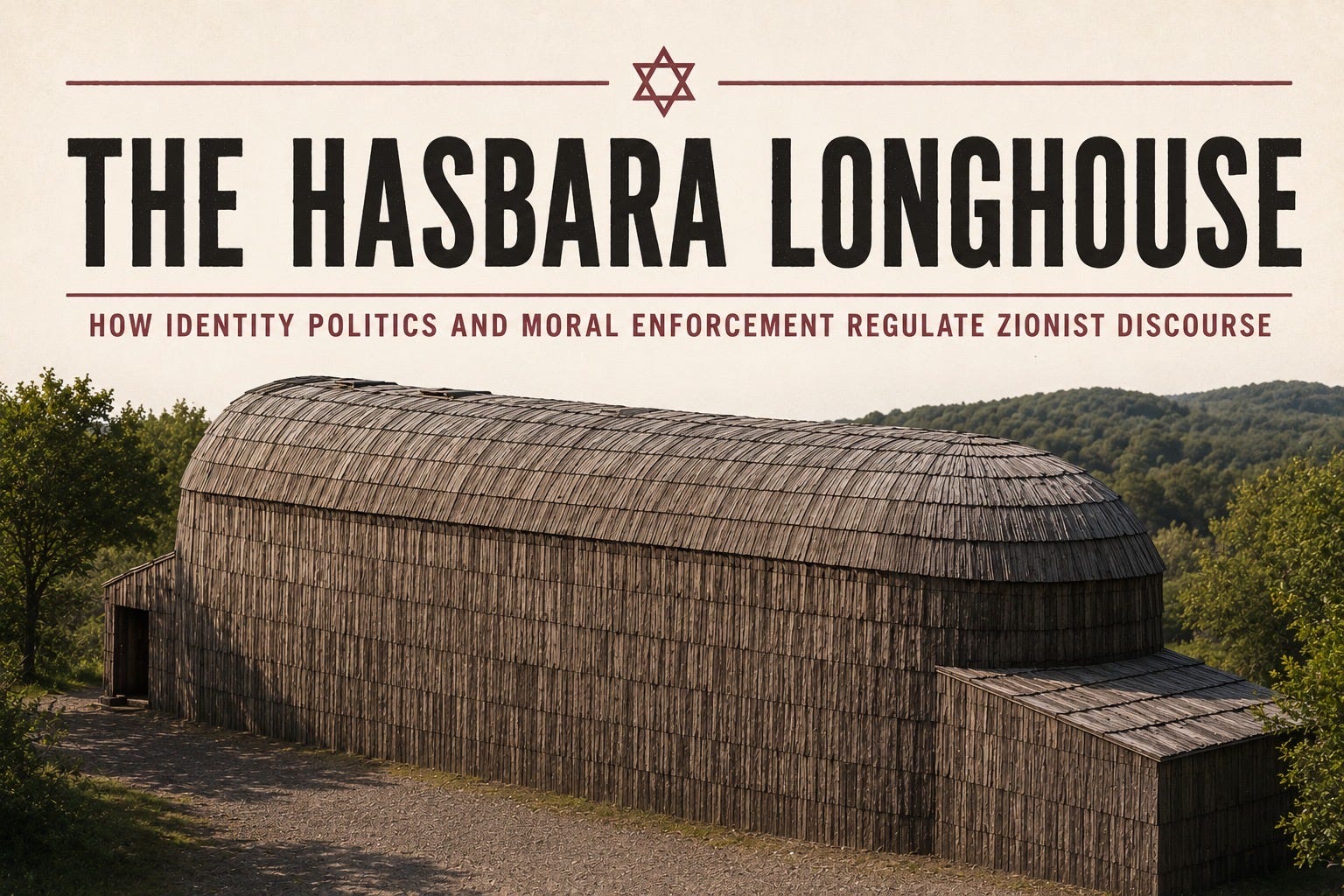
Public figures like Rudy Rochman, academics like Adam Louis-Klein, and organizations like the “Indigenous Embassy of Jerusalem” have advanced a discursive reframing of Zionism as a project of Indigenous decolonization aka a Jewish "Land Back." Instead of contesting the political framework of contemporary identity politics, this school of thought seeks to situate Jewish and Zionist identity within established categories of indigeneity, historical oppression, and decolonization.
The strategic and philosophical problems with this approach have been examined elsewhere. Rather than revisiting those arguments in detail, I want to focus on a different phenomenon: the social and moral order that has grown up around this discourse. This is the Hasbara Longhouse.
The term is adapted from Bronze Age Pervert's concept of the "Longhouse": a social order maintained less through formal coercion than through diffuse mechanisms of moral regulation, reputational sanction, and the policing of acceptable speech. The Hasbara Longhouse rests upon two mutually reinforcing pillars. The first is the strategic recasting of Zionism through the moral vocabulary of contemporary identity politics. The second is the therapeutic enforcement of the norms that follow from that vocabulary through accusations of harm, reputational sanction, and the policing of acceptable political speech.
One possible explanation for this development lies in the political sociology of American Jewry. As progressive hostility toward Zionism has intensified, many Zionist advocates have responded not by rejecting the moral grammar of progressive identity politics but by attempting to demonstrate that Zionism itself satisfies its criteria.
In effect, they have sought acquittal before a tribunal whose jurisdiction they have already conceded to.
Even if this strategic choice were accepted, it would remain unstable. The moral vocabulary of identity politics does not rest upon fixed anthropological categories but rather upon concepts whose meanings are continually contested and renegotiated.
A lot of contemporary identity politics draws upon traditions of critical social theory that question universal objectivity in favour of standpoint epistemology and socially constructed categories. The implications are apparent in Louis-Klein's work. "Indigeneity" ceases to function as a stable anthropological designation and instead becomes a contested political category. The United Nations has never adopted a single formal definition of indigeneity. Contemporary discussions generally invoke criteria such as self-identification, historical continuity, territorial connection, distinct institutions, and non-dominant status.
This framework is useful insofar as it rebuts antisemitic denials of Jewish peoplehood, historical continuity, and attachment to the Land of Israel. Yet it ultimately collapses on the final hurdle. Native populations do not automatically qualify as Indigenous in the contemporary political sense. Englishmen are indigenous to Britain in the ordinary meaning of the word, yet are not recognised as Indigenous under prevailing political usage, same goes for the Han Chinese of China. The same ambiguity applies to Jews, and it is routinely exploited by anti-Zionist activists.
Rochman's "decolonized Judean" and Louis-Klein's "indigenous Jew" serve markedly different intellectual purposes in pursuit of radically different political ends. Rochman argues for a return to what he regards as an authentic pre-diaspora Judean identity, to which the Ten Lost Tribes can reconnect and return, ultimately producing both a Jewish demographic majority and a pan-Levantine brotherhood of equals. Louis-Klein employs indigeneity as the basis for portraying anti-Zionism as a colonial and genocidal project of Indigenous erasure. Despite these differences, both approaches elevate indigeneity from a descriptive anthropological concept into a category of moral legitimacy that anti-Israel activists have spent decades employing against the Jewish state.
In both cases these are modern constructions that depart significantly from the mainstream tradition of political Zionism. Herzl, writing in the aftermath of the Dreyfus Affair, argued that assimilation and European liberalism would not save Jews from political persecution. Nordau's doctrine of Muskeljudentum sought the regeneration of Jewish character in a hostile world. Ben-Gurion and Labour Zionists grounded Jewish renewal in nation-building, agriculture, and statecraft. Revisionists appealed to history, sovereignty, and security. They disagreed profoundly about the character of the future Jewish state, but none argued that Jewish sovereignty derived its legitimacy from satisfying a contemporary theory of indigeneity.
The deepest problem with the Hasbara Longhouse is therefore not merely that it polices discourse. Every political tradition establishes boundaries of legitimacy. Rather, it is that Zionist advocacy increasingly adopts the epistemological assumptions of the very ideological framework from which many of its fiercest critics emerge. We’ve accepted our opposition’s home field as the battleground. By grounding its legitimacy in progressive theories of identity, indigeneity, and historical oppression, it renders itself dependent upon concepts whose meanings it neither controls nor can hope to control. The result is a politics that continually seeks recognition within a moral vocabulary developed by intellectual traditions fundamentally hostile to political Zionism. That is not merely poor advocacy; it is strategic self-subordination.
————————————————————————
Clavicular's controversial visit to Israel provides a concrete illustration of how the Hasbara Longhouse functions as a system of moral regulation rather than merely a new style of Zionist advocacy. Clavicular—and figures such as Yossi Farro, (and Shira Braun) who publicly associated with him—were met with fierce condemnation from critics advancing several interconnected arguments.
First, critics argued that the visit represented an insincere attempt to rehabilitate Clavicular's public image while obscuring his associations with figures commonly identified with the online "red pill" ecosystem and elements of the far right, including Andrew and Tristan Tate, Nick Fuentes, and Sneako.
Second, critics argued that refusing to publicly condemn Clavicular, or those willing to collaborate with him, constituted moral complicity in his alleged misconduct. The controversy was framed as a choice between protecting Israel's public image and protecting survivors of sexual violence, particularly Jewish women.
This style of argument—recasting strategic disagreements over public diplomacy as tests of personal virtue, safety, and moral legitimacy—is also familiar from activist movements such as Boycott, Divestment and Sanctions. What is notable here is not that such arguments exist, but that they have migrated into sections of Zionist discourse itself.
Public denunciations of Clavicular functioned as inexpensive signals of moral conformity. Whether any of his conduct merited criticism is not the analytical question. Public condemnation imposed little cost while demonstrating adherence to accepted—if largely unwritten—community norms. In that sense, condemnation became a public performance of ethical consensus more than a strategy for preventing sexual misconduct.
If one wishes to open the can of worms a little further, many of the loudest voices condemning Farro and Clavicular have been noticeably quieter when allegations of sexual misconduct have arisen elsewhere within the online Jewish ecosystem. If true, that inconsistency would suggest that the issue is not merely sexual ethics, but the selective enforcement of communal norms.
The controversy also had the unintended effect of treating Israeli women who voluntarily interacted with Clavicular as passive objects requiring protection from their own judgment. This sits uneasily alongside contemporary feminist commitments to female autonomy and agency. In attempting to protect women, critics sometimes appeared to deny those same women the capacity to make their own decisions about whom they associated with. For all the knighting on behalf of Jewish women, a 19 year old Jewish girl was harassed with barbarian language. Braun was correctly removed from her position, this isn’t a concern troll but the hypocrisy is potent here. Can’t have it both ways.
Clavicular himself is therefore almost beside the point. The controversy evolved into a broader conflict between competing conceptions of political legitimacy. One side regarded strategic considerations surrounding Israel's reputation as paramount; the other regarded adherence to a particular moral framework as a prerequisite for legitimate political participation.
Our criticism therefore cuts in two directions. We remain skeptical both of the strategic judgment exercised by those who invited Clavicular and of the moral framework employed by many of their critics. The latter reveals a style of politics in which strategic disagreements are translated into questions of moral purity and communal legitimacy. It is this second phenomenon that concerns us here.
That is the operating logic of the Longhouse. The decisive question is no longer whether an argument is strategically sound, historically grounded, or factually correct. Instead, controversy is processed through a moral grammar that determines who may legitimately participate in the conversation. The dispute becomes less about ideas than about moral status, with accusations of contamination, complicity, or social impurity policing the boundaries of respectable discourse.
The Longhouse prefers consensus to open conflict. This is antithetical to one of Judaism's defining intellectual traditions: vigorous disagreement in the shared pursuit of knowledge, wisdom, and understanding. It also reflects a historically naïve understanding of Zionism itself. The construction and preservation of Jewish sovereignty in the Middle East has always required difficult strategic compromises and cooperation with morally imperfect political actors.
The Abraham Accords are an obvious example. Israel normalized relations with the United Arab Emirates, Bahrain, Morocco, and Sudan—hardly bastions of liberal democracy or human rights. Yet those agreements arguably constitute the most significant diplomatic breakthrough in the region in decades. Zionism has therefore always involved strategic engagement with imperfect partners in pursuit of larger national objectives. The Clavicular episode merely surfaced the question of whether similar strategic reasoning can ever apply to public diplomacy conducted by private actors.
How one answers that question is ultimately less important than how the question itself was received. Rather than becoming the subject of open debate, it became evidence of moral deficiency on the part of those asking it. The limited pushback against the prevailing orthodoxy was met less with substantive refutation than with tone policing, reputational pressure, and online shaming.
The Hasbara Longhouse does not suppress disagreement primarily through censorship. Rather, it transforms disagreement into evidence of moral defect. Once politics becomes a contest over moral status rather than competing judgments about history, strategy, or reality, disagreement itself becomes interpreted as evidence of harm.
A political culture that treats disagreement as evidence of moral defect does not merely narrow debate. It impoverishes the strategic imagination on which every successful national movement ultimately depends.
I hope you have had a meaningful Nine Days.
Signed,
Abba Eban
I thought Yarvin coined this usage of the term longhouse but maybe BAP was first.
I generally agree that trying to win with decolonization talking points is a fool's errand. The best you can do is point up some hypocrisy on the part of new leftists. But you're not gonna out-Foucault the Red-Green Alliance of Reconstructionist Muslims.
I'm glad the message is spreading